
Tax-Conscious Investment Strategies for High-Net-Worth Individuals
Tax-efficient investing involves coordinated decisions about what you hold, where you hold it, and how you manage it over time. EP Wealth walks...
.png?width=1080&height=1080&name=LinkedIn%20with%20Light%20Blue%20Background%20(1).png)
.png?width=1080&height=1080&name=Facebook%20with%20Light%20Blue%20Background%20(1).png)

.png?width=1080&height=1080&name=Instagram%20(1).png)


2.16% a year, forever. How Box 3 punishes American investors in the Netherlands, and why that could soon change.
Working with Americans abroad has taught me that every country is its own puzzle. The tax treaties, the local rules, the way each system treats U.S. accounts. No two are alike, and the Netherlands is the sharpest example I’ve come across. Most of my Dutch-based clients first meet Box 3 as an unpleasant surprise, though it’s a far smaller problem when you plan around it in advance.
I work with U.S. clients across the U.K., Europe, the Middle East and Asia. Every country has its quirks. In my view, none of them stack up quite like the Dutch system does.
You’re taxed on returns you may never have earned. You’re largely locked out of U.S. funds by EU rules, and penalized by U.S. rules if you buy European ones instead. The 30% ruling shrinks to 27% in 2027, and partial non-resident status, which used to keep many Americans out of Box 3 altogether, is gone.
None of that is a reason to avoid the Netherlands. It’s a reason to stop running an American financial plan on Dutch soil and expecting it to work.
If you’re an American living in the Netherlands, there’s a decent chance you’ve had this moment. You’re at a birthday party, standing in a circle, holding a slice of cake you did not ask for, and someone says the words “box 3.” You nod. You have no idea what they mean. You go home and Google it. You wish you hadn’t.
Let me save you the Googling.
You still have a Schwab or Fidelity account back home. Some cash in the bank. Maybe a brokerage account you opened in your twenties and have barely looked at since. From a U.S. perspective, that’s just normal adult life.
From a Dutch perspective, a lot of it lands in Box 3, the wealth tax bucket. And Box 3 is changing again, because of course it is.
Here is the part that trips up almost every American I talk to. The Netherlands does not tax what your investments actually earned. It taxes what the government assumes they earned.
It sorts your assets into buckets (cash, investments, debt), assigns each bucket a deemed return, and taxes the result at 36%.
For investments, the assumed return is 6%.
Read that again. Six percent. Whether you own a global equity fund or a pile of short-term bonds that returned roughly the price of a stroopwafel, you’re in the same bucket. The tax doesn’t care how you’re actually invested. It cares what category you’re in.
There is a counter-evidence route if your real return came in below the assumed figure. It exists, it works, and it also means documenting your case to the tax authority every single year. It’s a fire extinguisher, not a floor plan.
So if you’re a long-term investor, this setup creates some genuinely strange incentives.
I worked with a younger client who was doing what a lot of thoughtful people do. All the risk in the IRA, taxable account kept nice and safe.
In a U.S.-only world, fine. Defensible. Reasonable.
Through the Box 3 lens, it was quietly expensive. Their careful, conservative taxable account was being taxed as though it had cheerfully returned 6%. It had not. It was never going to. The Dutch tax system did not care about its feelings.
So we flipped it. Move more of the growth assets into the account that’s being taxed like it holds growth assets anyway, and manage the overall risk somewhere else in the plan.
Nothing about their total risk changed. Only the address of each asset changed.
That’s the real question in cross-border planning. Not “what should I buy in this account,” but “where should each thing live across my entire financial life.”
Another client had just bought a house in the Netherlands and was sitting on a big pile of leftover cash. Very responsible. Also very visible to Box 3.
The reflex answer is “invest it.” We asked a different question: what if some of it went into the house instead?
A qualifying primary residence generally sits in Box 1, outside Box 3. So depending on the situation, less cash and more home equity can mean less wealth exposed to the wealth tax.
Was that the highest expected return on a spreadsheet? Probably not. But planning isn’t a contest to squeeze the most out of every individual dollar. It’s about the best result after tax, risk, liquidity and what you actually want your life to look like.
Sometimes the right advice is pay down the mortgage. Sometimes it’s hold more cash. Sometimes it’s move things around. And sometimes, to the eternal disappointment of everyone who wants a dramatic recommendation, it’s do nothing.
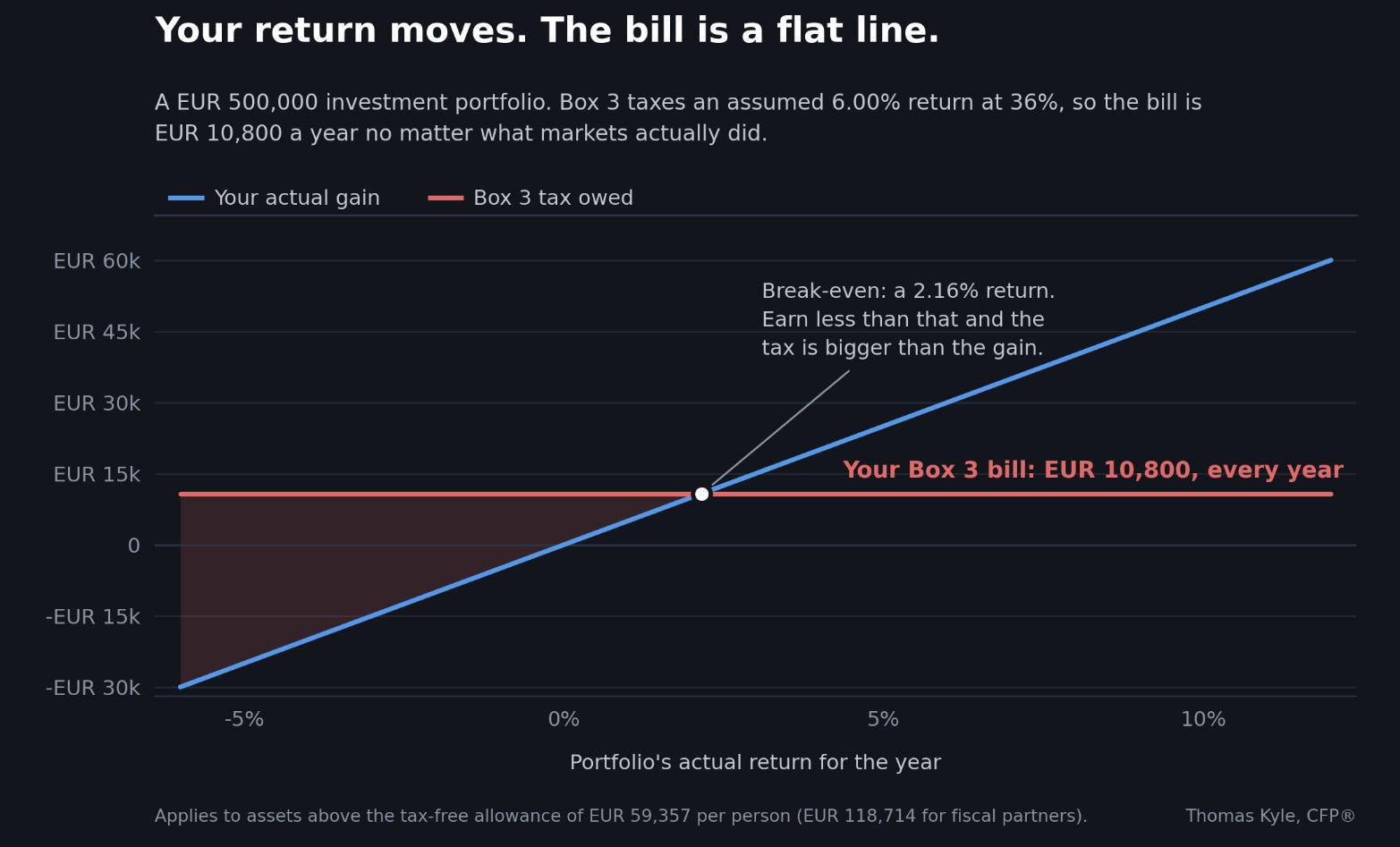
The Box 3 Problem: Your Returns Move. Your Tax Bill Doesn’t…
The frustrating part is that a decision can be smart under one tax system and a problem under the other:
Two tax systems, neither of which was designed with the other in mind, both of which expect you to have read the manual.
The Netherlands is moving toward taxing actual returns instead of assumed ones. The bill passed the lower house of parliament in February 2026 and is currently targeted to take effect on 1 January 2028. It still needs Senate approval, and the government has already signaled it may adjust parts of it in the 2027 Tax Plan. Treat 2028 as the direction of travel, not a date on a calendar.
Which is why I’d rather plan forward than react later:
Your Dutch accountant knows Dutch tax. Your U.S. CPA knows U.S. tax. Neither one is being paid to talk to the other.
That’s my job. Connecting the pieces so your investment strategy fits the whole picture, not just the half of it that fits on one tax return.
For Americans abroad, that kind of coordination is often worth far more than the investments themselves.
If any of this sounds familiar, or you feel like you’d benefit from a conversation about your own situation, feel free to connect. You can reach me directly here.
Sources and further reading:
Dutch rules
Expat rules
U.S. rules
DISCLOSURES
Thomas Kyle, CFP® is a Wealth Advisor with EP Wealth Advisors, LLC, an SEC-registered investment adviser. Registration with the SEC does not imply a certain level of skill or training.
This article is for educational and informational purposes only. It is not individualized investment, tax, legal or accounting advice, and it is not an offer or solicitation to buy or sell any security or to engage EP Wealth Advisors for advisory services. Nothing here should be acted upon without consulting qualified U.S. and Dutch tax professionals about your own circumstances.
Tax rules referenced are those in effect, or proposed, as of the date of publication and are subject to change, sometimes retroactively. The 2026 Box 3 percentages for bank deposits and debts are provisional and are expected to be finalized in early 2027. Proposed legislation, including the move to taxing actual returns from 2028, may be amended, delayed or not enacted at all.
Client examples are illustrative. Identifying details have been changed or combined, and they are not representative of the experience of any particular client or of all clients. They are not a testimonial or endorsement, and no compensation was provided in connection with them. There is no assurance that any strategy described will be suitable for, or produce similar results in, your situation.
The EUR 500,000 portfolio shown in the chart is hypothetical and used only to illustrate how the Box 3 calculation works. It does not represent an actual client, account or investment, and it does not reflect the tax-free allowance, deductible debts, partner allocation, the counter-evidence rule or any other facts specific to a taxpayer. Your actual liability will differ.
Investing involves risk, including possible loss of principal. Cross-border portfolios carry additional risks, including currency risk, differences in reporting requirements, limited fund availability and the potential for the same income or assets to be treated differently by two tax systems. No strategy assures a profit or protects against loss.
Third-party information is believed to be reliable but has not been independently verified. Links to third-party sites are provided for convenience and do not constitute an endorsement of their content.
EP Wealth Advisors does not provide tax, legal or accounting advice.
Request an appointment with an EP Wealth Advisor when you have a minimum of $500,000 in investable assets – which includes qualified retirement plans (IRA, Roth IRA, 401(k), taxable brokerage, cash (savings / checking) and CDs. Investable assets do not include your home, vehicles, or collectibles.
EP Wealth Advisors, LLC. is registered as an investment advisor with the SEC and only transacts business in states where it is properly registered or is excluded or exempted from registration requirements. SEC registration does not constitute an endorsement of the firm by the Commission, nor does it indicate that the advisor has attained a particular level of skill or ability.
Tax-efficient investing involves coordinated decisions about what you hold, where you hold it, and how you manage it over time. EP Wealth walks...

Capital gains taxes affect investment decisions, charitable giving, and estate planning. EP Wealth explains how high-net-worth investors can approach...
British expats in the US may face unexpected UK tax bills. Learn how HMRC's five-year rule, new dividend rules, and state taxes can impact your...
Tax-efficient withdrawal strategies can help high-net-worth families manage taxes, avoid Medicare surcharges, and support long-term legacy planning.
